Maximize. Validate. Control.
The most matches possible
Typically a 40–200% lift in validated match rates vs. your status-quo first-party matching, because ID Max resolves every durable, real ID for a person and household rather than only the one you happened to collect.
Every one of them real
The only identity matching service that validates as it resolves: every linkage independently scored against Truthset’s Validation Sets, deterministic ground truth spanning 1.4M US consumers, and graded into Data Ratings tiers (AAA–B) anchored to census.
You set the accuracy bar
Transparent and configurable. Tune the accuracy threshold by use case, tightening it for measurement and opening it for reach, and always know which matches are which.
1:1 resolution against a graph of graphs.
ID Max resolves first-, second-, and third-party data 1:1 against Truthset’s Mastergraph: 302 million Person IDs and 129 million households, at census scale.
It runs on declared PII only. Email, phone, name and postal address. Never a cookie, MAID, IP, or CTV ID, so nothing in the match ages out as the ecosystem shifts.
Every number in the graph comes from cross-checking 24+ Data Collective providers against each other rather than taking one provider’s word for it. If one provider’s data drifts or the relationship ends, the graph absorbs it. If a new source emerges, it gets evaluated in.
MEET THE DATA COLLECTIVE →validated people
validated households
emails contributed & cross-validated
postal addresses
providers in the Data Collective
Data Ratings tiers, most files land in AAA
One email in. The whole reachable household out.
Your file holds one email per customer, usually the one they typed at checkout. People run on several addresses. Checkout against login, personal against business, purpose-specific inboxes, and churn under all of them.
Status-quo matching finds the one string you collected, or nothing. ID Max resolves the string to the person, returns every validated email that person actually uses, then every validated ID for the adults in their household, where purchase decisions actually get made.
That’s the arithmetic behind the lift: 4.5 validated emails per person and 10.1 per household. The match you were about to lose to email divergence becomes a person; the person becomes a household; the household becomes reach you already earned but couldn’t see.
It’s also why the lift is largest exactly where your file is weakest, on older CRM records, single-channel signups and checkout-only addresses.
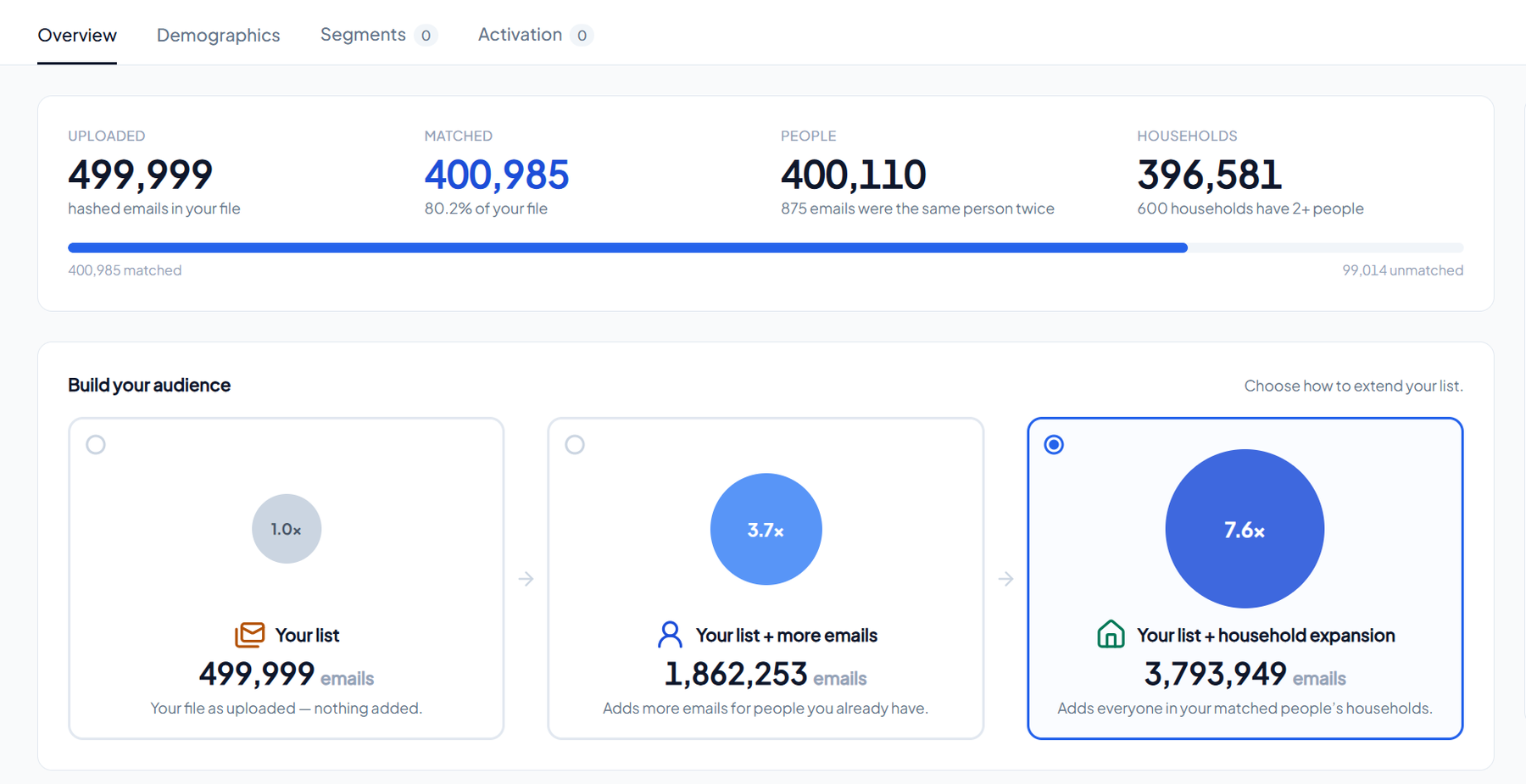
Grow past your file without diluting it.
SEE THE DATA RATED AUDIENCES PRODUCT PAGE →Once your file is resolved and validated, ID Max extends it with multi-sourced records from the Data Collective, participating providers representing 95% of the U.S. Census, with each incremental record scored and filtered before it joins your audience.
Expansion is configurable rather than a black-box lookalike. Include or suppress your originals, expand toward census-representative targets, and keep the same Data Ratings grading (AAA–B) on every added record that your matched file carries.
Demographic Profile
A validated demographic and identity read on the audience you already have, before you spend against it.
Seed Expansion
Grow from your matched seed with validated Collective records. Originals included or suppressed, your call.
Census-Target Reach Expansion
Build toward a census-representative target straight from the Data Collective when your seed isn’t the ceiling you want.
Every linkage carries a score.
Data Rated Identity grades every source and every incremental linkage into Data Ratings tiers (AAA–B) against Truthset’s Validation Sets: independent, multisourced panels of deterministic, declared data covering 1.4M US consumers. That is the ground truth that trains the scoring model, with results tested against a holdout group and benchmarked to census. Grading is what separates a validated match from a modeled one, and it is independent.
| Black-box graphs | ID Max | |
|---|---|---|
| Accuracy | Inaccurate and opaque. Unknown mistakes, zero control | Transparent and configurable. You set the accuracy bar |
| People | Inflated audiences. Errors counted as reach | Validated IDs. Real people |
| Scale | Accuracy traded away for reach (or reach for accuracy) | Maximum validated ID scale at 95% U.S. Census coverage |
| Proof | “Trust our match rate” | Every linkage graded into Data Ratings tiers by an independent referee |
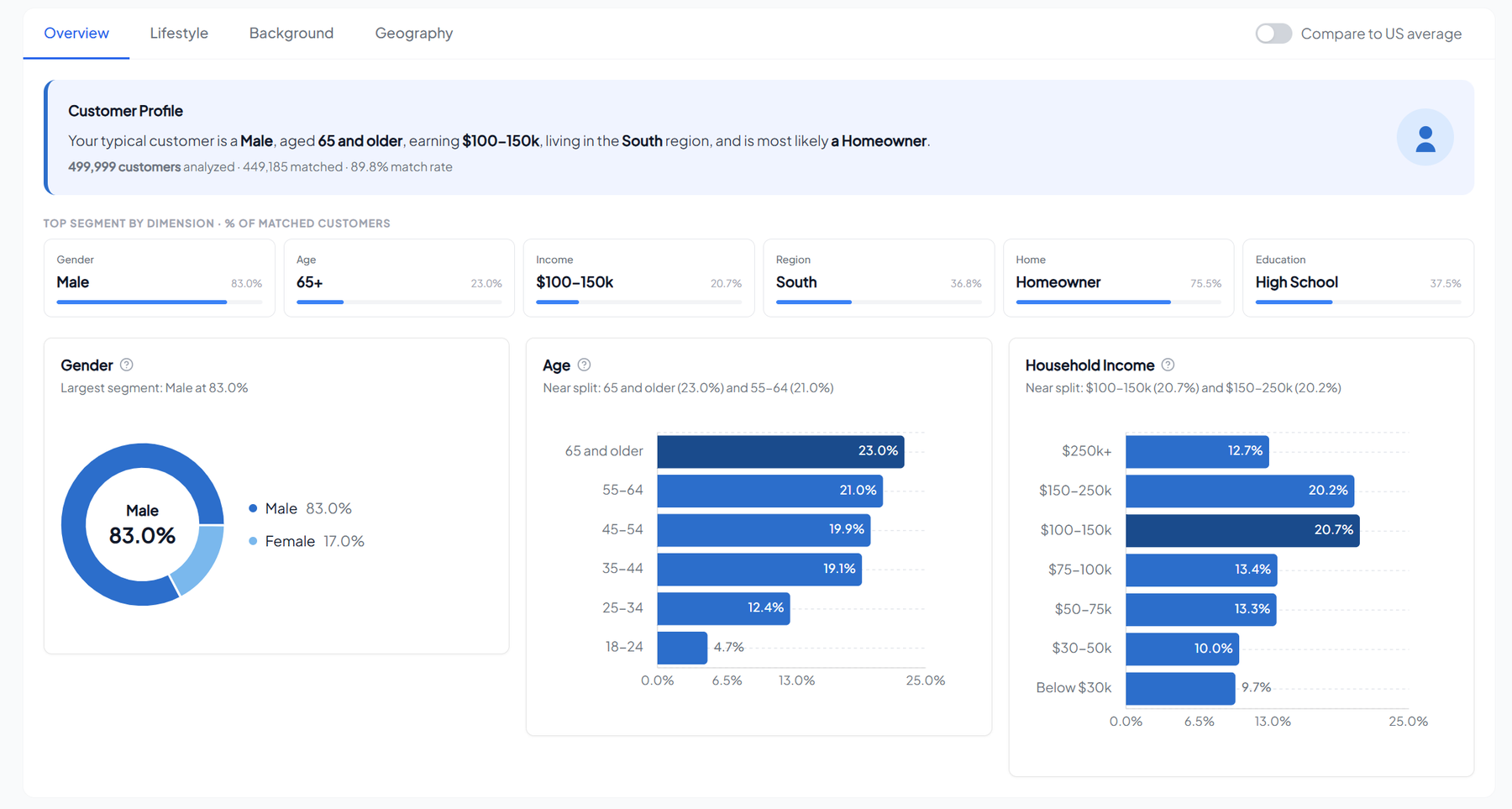
Know who you matched, and prove it.
Every resolved audience carries 25+ demographic attributes, cross-validated across the Collective rather than copied from one vendor’s file. The audience you activate is the audience you can describe to a client, defend to a measurement partner and price to a buyer, with error rates you have seen rather than assumed.
One hop, from your file to the screen.
ID Max audiences are keyed to declared PII, the identifiers every serious platform matches on directly. There is no cookie, MAID, IP or CTV ID in the chain to deprecate, drift or get re-keyed by an intermediary, so the file you validated is the file that activates.
Data Rated Audiences are integrated directly into The Trade Desk, Yahoo, Magnite, FreeWheel and Databricks, with the stack interoperable across dozens more marketplaces, DSPs and publishers. Resolution also runs inside Snowflake and Databricks, so nothing has to move to get matched.
DSPs
The Trade Desk and dozens of DSPs and marketplaces, with validated audiences available where the buy is made.
SSPs & publishers
Magnite, Yahoo and authenticated publishers, with graded audiences on the sell side.
CTV & streaming
FreeWheel, with Data Rated Audiences live inside the ad-buying platform, plus Roku and Paramount.
Warehouses & clean rooms
Snowflake and Databricks, resolving and validating where your data already lives.
Social platforms
Validated seeds into Custom Audience facilities, the same validated people inside the platforms’ own match flows.
Marketplaces & more
Dozens of marketplaces, DSPs and publishers, and growing. If your platform is not listed, ask.
Usage-based. Pay for validated matches, not promises.
ID Max is priced on usage: you pay per validated match, not a platform fee for a black box. Start with a free Match Test on up to 100K records, see your validated lift on your own file, then scale from there, directly, through your agency, or embedded in the platforms you already use.